

Bricks for PTSD
Featured Post #29


Featured Posts are hand-picked by our volunteer team to showcase the excellent work our community members are doing. In keeping with SmallStack’s mission to lift up small publications, all Featured Post authors have fewer than 500 subscribers. Think of it like staff picks at your favorite indie bookstore.
Today’s Featured Post is by InGameScientist, author of Just One More Turn, and was selected by SmallStack team member Cheshir. Cheshir writes:
It was hard to pick just one article from this publication, but this one discusses something that anyone can try out. There are moments where certain memories just won’t leave, so I was very intrigued to learn that Tetris, of all things, had the ability to make those memories a bit more manageable. I wonder what other things we can learn from video games!
A SmallStack Featured Post
Bricks for PTSD
How a 40-year-old game could help with stress
By InGameScientist
Long ago, I watched the horror film The Ring in Japanese. I was sick at the time and figured my dulled senses would protect me from the horror. Nope. The movie cut through the sickness like a melt-in-your-mouth brisket, jump scaring away my blocked sinuses.1 The disturbing thing about this movie was not the short-term therapeutic effect it had on me, but the lingering horror that remained long after the credits rolled.
Much of the lingering horror was due to scenes from the movie replaying in my head. The scene was traumatizing enough that my brain would conjure up that scene at the most inopportune times — something that didn’t help the sleepless nights afterwards.
There is a name for these special, trauma-induced memories: intrusive memories. They aren’t like the multiplication tables that you recall during a test or the location of a secret item that you discovered in a video game. Intrusive memories well up when you don’t want them to and can cause serious problems like disrupting concentration. It’s actually a core symptom of post-traumatic stress disorder (PTSD).2
Of course, intrusive thoughts aren’t the only symptom of PTSD. But treating it somehow may make treating the rest of the symptoms of PTSD easier. Interestingly, the solution lies with a 40-year-old video game.

Falling blocks
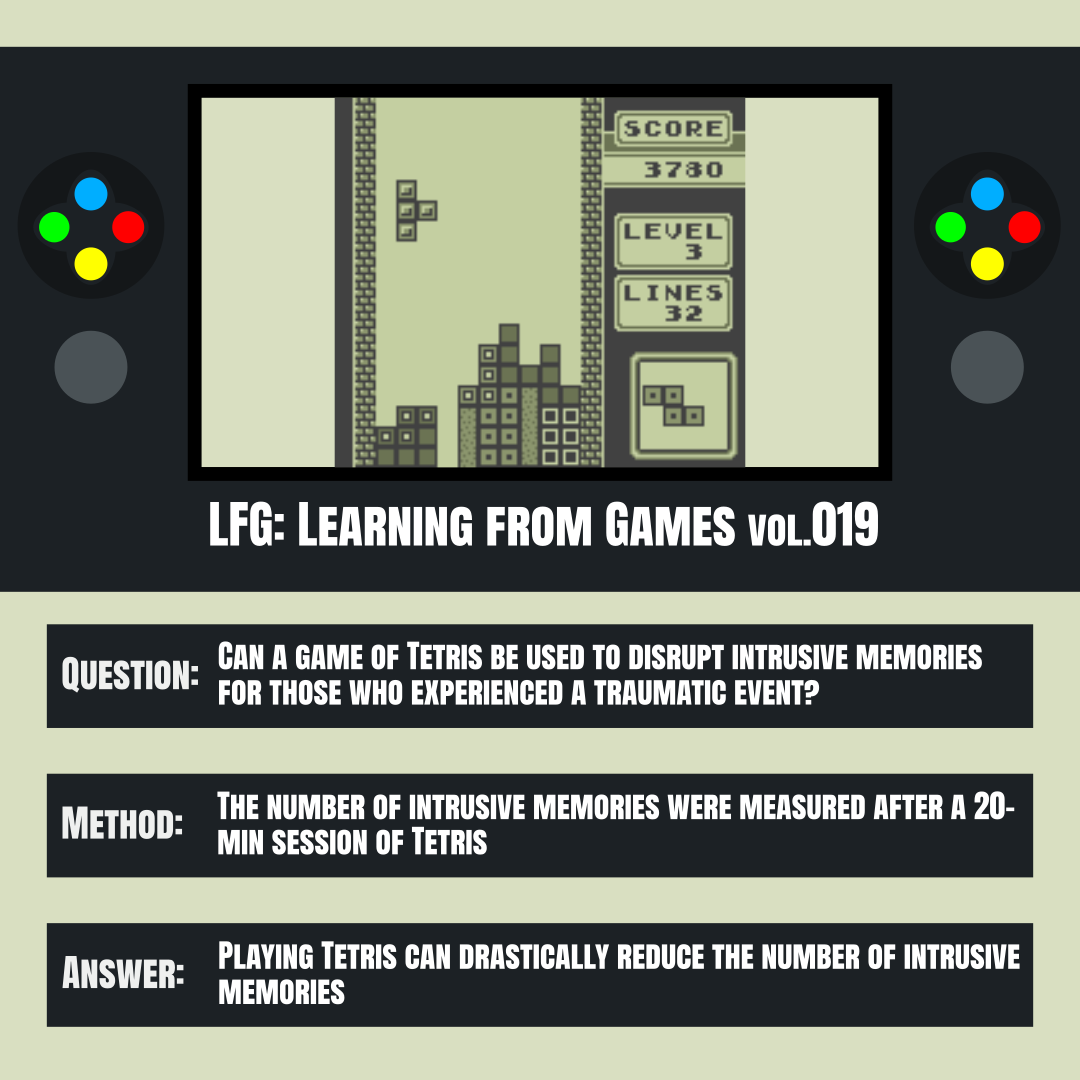
The video game in question is Tetris. Yes, that game where differently shaped combinations of four squares come raining down at ever-maddening speeds. Tetris requires the player to rotate these shapes to fit them into the puzzle below before they pile up. This requires a part of the brain called visuospatial working memory: a short-term memory that stores and manipulates images in space (rotation) and where they are if they are moving.
It just so happens that the part of the brain involved in intrusive memories also uses visuospatial working memory. The best guess why Tetris seems to work against intrusive memories is competition for limited mental resources. Visuospatial working memory has limited bandwidth to remember the images in its short-term memory. When idle, intrusive memories can take up all of the bandwidth, allowing those unwanted thoughts to intrude.
But if you give it something else to do, like rotate different Tetris blocks, you overload this part of the brain with different shapes every couple of seconds.3 Now, your brain can’t focus on the intrusive images because it’s too busy rotating blocks and getting frustrated when they don’t fit neatly in the puzzle.
So, researchers in Sweden decided to test whether Tetris could be used to disrupt the intrusive memories formed during the COVID-19 pandemic in frontline healthcare workers.
20 minutes of Tetris keeps the bad thoughts away
The Tetris-as-a-therapy idea was first tested in a rather cruel test (for me anyway, as I am not a fan of horror movies or games) called the trauma-film paradigm.4 This particular test required the participants to watch a 12 minute film full of traumatic scenes of injury and death. After a 30 minute rest period, the participants were briefly reminded about the traumatic film before doing nothing (control) or playing Tetris (treatment) for 10 minutes. The participants were sent home with only the requirement to log any intrusive memories everyday for a week.
Dramatically, the number of intrusive thoughts decreased in those who played Tetris compared to those who did nothing.

The findings have been repeated by other researchers.5 In the Swedish study of frontline healthcare workers, these results were applied to the workplace. In other words, instead of being shown a traumatic film, participants were asked to recall a traumatic event at work before they played Tetris for 20 minutes.
The results were largely the same. By the fifth week after recalling the traumatic event, those who played Tetris had far fewer intrusive memories than the control group that listened to a radio or podcast.

The good news doesn’t stop there though. For 6 months after the initial treatment, those who played Tetris reported fewer post-traumatic stress symptoms, including symptoms related to intrusive memories. Secondary effects, like lower stress and burnout were also reported by those who played Tetris, compared to the control group.
Why is it important?
Other than the fact that Tetris(!) can be used to help ease symptoms of PTSD or deal with traumatic events at work, Tetris is one of the only examples where a video game is thought to directly affect the mechanism of a disease.
Most other uses of video games is for rehabilitation (exergames), education (serious games), or to lessen the effects of a disease after it has happened. But in the case for using Tetris to reduce intrusive memories, the game can prevent a key symptom of PTSD from gaining a foothold. It’s a golden standard in the treatment of any disease: prevent it before it can cause damage.
There is another important benefit: it’s a rare example of a do-once treatment. Play Tetris after reminding yourself about an intrusive thought and that should lessen the number of times that intrusive memory bothers you in the future. Many other treatments turn into a marathon of reminders, but not this one. It’s a boon for those like me who are prone to forget to take medications or undergo treatments.
What’s the catch?
One key thing to keep in mind is the complex nature of PTSD and that Tetris was used to address one portion of the whole of PTSD. Tetris was very specifically studied for its effect on intrusive memories, which are a part of PTSD. Like many video game-based therapies, Tetris should be used in combination with other therapies for PTSD, under the guidance of a healthcare professional.
It’s also unclear just how much of an impact a treatment like this would have on a complex disorder like PTSD. While Tetris can help reduce the frequency of intrusive thoughts, how that reduction affects other symptoms or makes them treatable (or not) is not clear. That’s because this study recruited anyone with intrusive thoughts about the workplace — regardless of whether they had PTSD or not.
Looking ahead
The fact that researchers were able to show an effect outside of a controlled laboratory setting is what sets this apart from other similar studies. Not only that, participants in this study only needed to recall the intrusive memory, meaning that Tetris can be effective long after the actual traumatic event.
My secret hope is that researchers will start to look more deeply into why games have the effect that they do and match it up to something we do in the real world. Maybe it’s something about how we learn games that can be applied to our educational system. Or the brain processes at work when we play FPS games that can translate into disrupting other unwanted mental processes.
I think the possibilities are endless.
If you want to read more about this study, you can access the article here for free: https://bmcmedicine.biomedcentral.com/articles/10.1186/s12916-024-03569-8
About the author
Shu (InGameScientist) is a self-proclaimed gaming and science nerd, who has been playing video games since the NES and Gameboy days. Nowadays, he mainly plays indie strategy and tactics games on PC, all while thinking about the impact of video games on human health and education. Using his PhD background and his love for turning complexity into simplicity, he mashed together gaming and science in writing, hoping to give that "Just One More Turn" feel to the newsletter. If you're curious about how video games can be used beyond entertainment purposes, join the community at Just One More Turn.
Just One More Turn is a weekly publication that discusses video games and its impact on human health and education beyond entertainment. Complexity -> simplicity in a format you'll want just one more turn of.

Join the conversation
Did you enjoy this Featured Post as much as we did? Leave a comment and let the author know what you loved most!
Stay tuned for more Featured Posts!
To showcase the breadth and depth of talent in the SmallStack community and celebrate the launch of the SmallStack Library, we release a different Featured Post every Friday. Do you have a favorite small publication you’d like to nominate? Let us know, and it might appear on a future Featured Post Friday!
This was the day I discovered jump scares could help me, not hurt me, by clearing away blocked sinuses. I am tempted to put on a horror movie every so often especially when suffering from sicknesses or allergies, but I always reach for the medication instead.
https://www.psychiatry.org/patients-families/ptsd/what-is-ptsd
This site explains PTSD briefly; intrusive thoughts are listed as the first symptom under Symptoms and Diagnosis.
Of course, this depends on how advanced you are and how fast those blocks are falling. But even at the slowest speeds, you’re still processing a new shape fairly frequently.
https://journals.plos.org/plosone/article?id=10.1371/journal.pone.0004153
This article describes the trauma-film paradigm test and the results after participants played Tetris. This might be one of the first examples where video games directly affect a disease process.
https://journals.sagepub.com/doi/abs/10.1177/2167702620906148
This article replicates the findings that playing Tetris can decrease intrusive memories. Unfortunately, I don’t have access to the full study, but the abstract tells the tale.
 | A guest post by
|
I heard something similar in a radio program not long ago, that people who were subjected to traumatic events and were provided with just ten minutes of time playing a strategy video game had fairly significant reductions in stress from that traumatic event. I'm pretty sure it was this study, now that I'm reading your take on it. And.... science is just so cool!!
I am neither a horror movie fan nor have I played more than a single game of Tetris but I am a retired clinical psychologist. I have used eye movement desensitisation with PTSD (especially military personnel).
Now, retired for more than 20 years, I haven't kept up with the psychotherapeutic literature. What a simple but apparantly effective self-help treatment for PTSD and intrusive visual images (possibly any intrusive thoughts). Wonderful! Thanks so much for this. I have no professional need for this now but I will readily recommend it to others.